
REVIEW · WALKING TOURS
Best of Buenos Aires Private Walking Tour
Buenos Aires turns Paris-like when you walk it. This private, English-guided stroll connects the city’s famed architecture with the stories behind it, from Calle Florida to La Recoleta Cemetery. I love how fast the tour makes the center feel understandable, and I love the way the guide ties buildings to real events, like British influence and the Malvinas War.
My only caution is that this is not a sit-down tour. You’re on your feet for about 2.5 to 3 hours, and one part depends on timing, weather, and street conditions, so wear comfy shoes and keep your schedule flexible.
Quick highlights
- Calle Florida and the downtown-to-park “spine” that frames early Buenos Aires
- Edificio Kavanagh, the Art Deco skyscraper with UNESCO heritage status and a fast build story
- Torre Monumental plus the Malvinas memorial, a clear view of Britain’s long shadow
- Barrio Norte palaces and mansions, including Paz and San Martin palaces with French connections
- Recoleta’s church cluster and the detailed cemetery segment with major local names
- End at La Biela, a perfect spot to grab a coffee and keep exploring nearby
More of Buenos Aires on foot
- Buenos Aires Hop-On Hop-Off Bus, Free Walking Tours & Discounts★ 4.5 · 2,218 reviews
- Buenos Aires: La Boca Guided Walking Tour in English★ 4.8 · 1,587 reviews
- Nazis in Buenos Aires: a historical walking tour★ 4.9 · 193 reviews
- Buenos Aires: Personalized 2 to 8-Hour Private Walking Tour★ 4.7 · 149 reviews
Why this walk makes Buenos Aires feel like Paris of the South
Buenos Aires earns the nickname Paris of the South most clearly in the details. As you move through downtown and then up toward Recoleta and Barrio Norte, the city starts showing its “European” posture, with wide avenues, ornate facades, and old mansions that look like they belong in a different country.
The real win here is that the tour does not treat architecture like decoration. You learn why these buildings got funded, who built them, and what politics and culture were swirling underneath. That makes the walk feel like a guided storyline, not a checklist.
Meeting at 10am near Paraguay Street, then getting into walking mode
You meet in the downtown core at the Buenos Aires Walking Tours starting point, outside the cafe corner door on the corner with Paraguay Street. The start is no later than 10:00am, and the guide will be easy to spot with a small BA Walking Tours sign.
Plan for a lot of time on sidewalks. The tour runs rain or shine, and the pace is brisk but not punishing, according to past experiences I’ve seen. If you can keep walking steadily for a couple of hours, you’ll be fine, even if you’re not a “fitness person.”
One practical bonus: this is private. That means you can ask questions without waiting for a group to catch up, and the guide can adjust the flow when the street gets crowded.
Calle Florida to Plaza San Martin: the downtown hits you first
After meeting, you head to Calle Florida. This is one of the oldest streets in town, and the guide uses it like a map of Buenos Aires’ growth, connecting the foundational area around Plaza de Mayo to Plaza San Martín (San Martín Park). It’s also a shopping street, so you’ll be surrounded by city life while the guide narrates the city’s early days.
Next comes Basilica del Santisimo Sacramento, built in 1916 by Lady Mercedes Anchorena for her family. It’s one of those places where the building itself feels like a plot. The guide shares the quirky love-hate-power stories tied to the chapel and family behind it, and you get a sense of how elite families shaped Buenos Aires’ public and private spaces.
Then you hit one of the tour’s headline views: the Edificio Kavanagh. This tallest Art Deco skyscraper in Buenos Aires sits by Plaza San Martín, and it was once the highest skyscraper in Latin America. You also learn a standout fact: construction took only 14 months, commissioned in 1934 by Corina Kavanagh, a millionaire of Irish descent who sold two ranches at age 39 to build the landmark. It’s the kind of detail that turns a photo backdrop into a real story.
Other private days in Buenos Aires

Kavanagh to Malvinas: Britain shows up in the skyline and the memorial
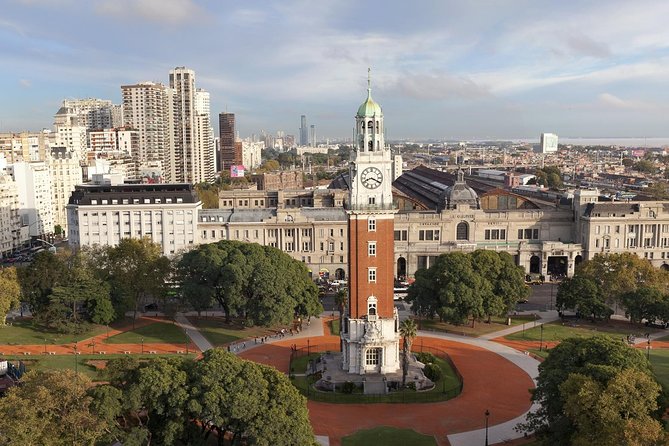
From the Art Deco tower, you move toward the city’s British imprint. The Torre Monumental is now called that, but it started as a British clock tower, and the guide explains how England’s legacy shows up in Argentina beyond old stereotypes.
Opposite the tower is the memorial for the 1982 South Atlantic war, known locally as Malvinas. The guide connects the monument to the deeper love-hate relationship between Argentina and Britain, including how British presence ran through the economy. You’re standing in a spot that forces a question, not just gives a view: how can a shared history become both influence and conflict?
It’s a strong emotional stop because you’re looking at architecture and then immediately at national memory. You get the feeling that Buenos Aires built its skyline at the same time it was building its identity.
Plaza San Martin and the palaces: where power wore fancy clothes
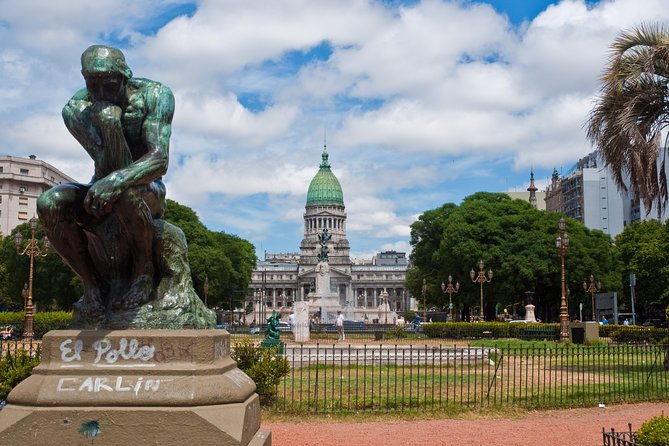
You spend time at Plaza General San Martín, a park area close to old slave depots and tied to earlier city uses like a fort and even a bullfight ring. Today, the park centers on the monument to Gral. José de San Martín, and the guide tells his full story, not just the name on the stone.
Next you step into palace territory, starting with Palacio Paz. This impressive city-palace was built in 1914 for José C. Paz, described as the proprietor of the city’s then-second most-circulated newspaper and an aspiring president. The French connection is literal: the building was constructed with material imported from France, and the guide points out the scale, including the home built for a family of four with around 120 rooms.
Not far away is Palacio San Martín, which the guide frames as the Anchorena family palace, later renamed for political reasons. The story here focuses on Mercedes Anchorena, and you also get a link to a nearby family church, showing how Buenos Aires’ wealthy groups shaped both grand residences and religious spaces.
You then continue through the elegant street styling of Barrio Norte with stops that highlight palatial density, including Palacio Estrugamou. The guide explains immigration patterns from the late 1800s into the early 1900s and connects those waves to the kind of housing and architectural style you see today.
If you like walking where the city shows its “why,” this section delivers. Each palace stop turns into a mini lesson on money, influence, and ambition.
Embassies, churches, and the stories you would miss on your own
As the walk keeps moving, you hit religious and diplomatic architecture that most self-guided walks either skip or misunderstand. You’ll see Plaza Israeli Embassy, where a 1992 bomb blast destroyed the embassy and killed 24 people. The guide explains what happened and why it matters in Argentina’s broader political and justice context.
Then you stop at the Embajada de Francia, originally the Ortiz-Basualdo Palace. One of the story beats is the visit of Edward the VII of England with his American wife-to-be. It’s the kind of detail that makes a facade feel like a historical meeting place, not just a pretty building behind fences.
You’ll also visit Embajada De La Santa Sede Nunciatura Apostolica, where the guide ties together religious influence, Argentina’s relationship with the church, and how elite women connected to the Vatican through donations and patronage. Even if you don’t care much about political theology, the human stories help.
Religious stops continue with Basilica de Nuestra Señora Del Pilar in Recoleta. This colonial basilica is completed in 1732 and is described as the second-oldest church in Buenos Aires. The point is not just age, it’s how the building anchors the neighborhood’s older story before modern wealth takes over the streets.
This whole section is valuable because it gives you context for the city’s layered identity. Buenos Aires is both ceremonial and complicated, and the architecture reflects that.
Patio Bullrich and Avenida Alvear: French elegance meets old trade
Before Recoleta fully takes over, you pass Shopping Patio Bullrich, a standout transformation. The building used to be a British horse-and-cattle auction house, designed by English Argentine architect Juan Waldorp, built in 1867 for the Bullrich family. Later, around the 1990s, it became a posh mall, but the guide shows you how the auction history shaped the structure and status.
This is another moment where the tour earns its keep: it shows you that Buenos Aires’ “high-end” look often comes from old business infrastructure. Once you learn that, you start spotting the city’s logic everywhere.
Then the tour leans hard into elegance with Avenida Alvear. The guide strolls you along its most refined stretch and explains its lavish mansions. The talk also connects the avenue to the broader story from 1880 to 1930 immigration and to the rise and fall of Argentina in those eras. If you enjoy architecture tied to social change, this is one of the more satisfying segments.
Recoleta and La Recoleta Cemetery: the tour’s most story-heavy hour
The walk reaches Recoleta, an affluent area known for Paris-style townhouses, lavish former palaces, and posh shopping. The guide keeps it moving so you get the feel of the neighborhood without wasting time searching for the important parts.
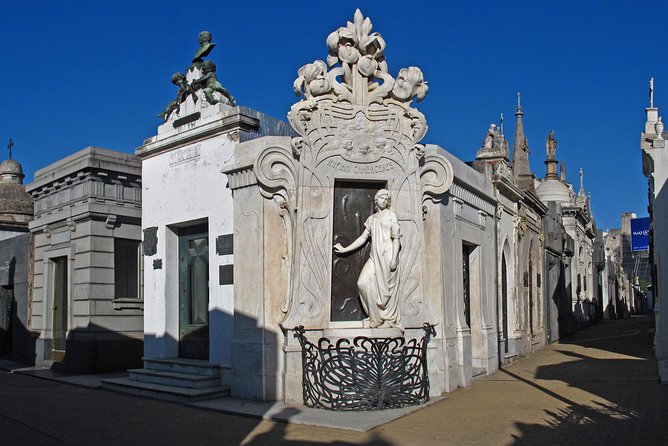
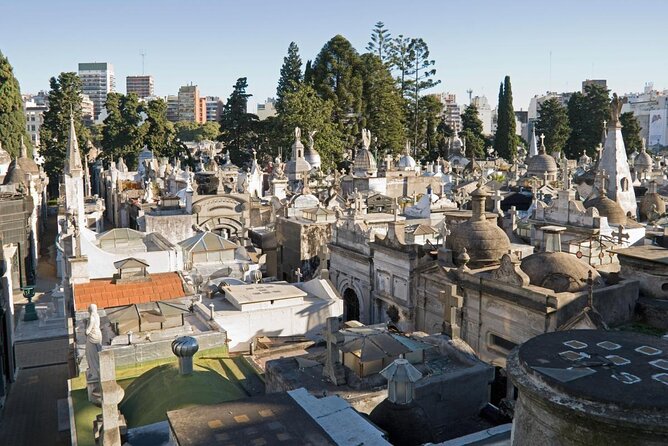
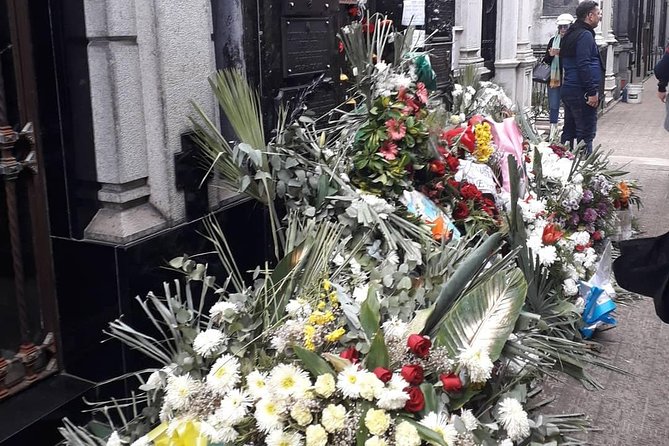
Then comes the big segment: La Recoleta Cemetery. This is not a quick stroll past tombstones. It’s a detailed visit, anchored by Evita Perón and her memorial and story.
You also hear about other striking figures and family tragedies, including Rufina Cambaceres, Admiral Brown, and names tied to wealth and influence such as the Leloir family. There are also stories connected to personalities like General Guido and Liliana Crociatti. The guide’s method is simple but effective: you understand who is buried where, then you connect it to why Buenos Aires cared so much about lineage, image, and legacy.
The cemetery segment is also where the tour may stretch beyond the core graves, depending on time and conditions. You might get pointers to nearby highlights listed as part of that segment, including Pilar Basilica, a cultural center and old monastery, Bourdelle’s Monument to Alvear, Palais de Glace where tango is described as coming of age, and stops and views that connect tango history to ports and immigration. The same segment may also include other nearby attractions such as the National Library and Loma Mitre area, plus monuments to France and Argentina, and the National Fine Arts Museum, when time allows.
That flexibility is a real consideration. The tour notes that full coverage depends on weather, timing, and city dynamics like strikes or repairs. So if you have limited time in Recoleta, make sure you plan to return afterward if you want to linger.
Ending at La Biela: a clean way to keep exploring
You finish just outside La Biela at Av. Pres. Manuel Quintana 596, where the guide explains the neighborhood and nearby attractions. It’s a smart landing spot because you can decompress with a drink and then choose what to do next on your own, instead of being dumped in an empty place with no plan.
I like endings like this, because the tour gives you direction without trying to control your whole day. If your energy is still decent, Recoleta is the kind of area where one more hour walking can be as satisfying as the first.
Price, value, and who this is best for
The price is $109 per person for a private walking tour of roughly 2.5 to 3 hours. That sounds like a “city-guides aren’t cheap” number until you count what’s included: a professional English-speaking guide and the cemetery admission ticket. Most of the other sights are viewed on the street or in free-access areas, so your biggest cost is really expert time plus the cemetery entry.
This makes sense if you want history and architecture, but not in a classroom voice. The guide uses humor and storytelling, and multiple guides have been highlighted for standout English skills, like Mariano, Martin, and Carlos. I also appreciate that pacing can stay easy enough that you do not need to be super athletic, as long as you can keep up on foot.
This tour is ideal if you:
- Want a first-time Buenos Aires orientation that goes beyond the usual top three stops
- Love architecture with context, not just names on buildings
- Plan to explore further on your own right after, especially around Recoleta
It may not be the best fit if you:
- Hate walking for 2.5 to 3 hours
- Need frequent long seating breaks
- Have very tight mobility constraints, since it is rain or shine and you’re moving most of the time
If you’re deciding based on satisfaction, the tour has a 4.6 rating and a 92% recommendation score, which lines up with the idea that the stories and guide style are a major part of the value.
Should you book Best of Buenos Aires Private Walking Tour?
I’d book it if you want your Buenos Aires day to feel guided, story-driven, and visually rich, without getting stuck on a bus or wasting time guessing what’s worth your attention. The strongest part is how the walk connects downtown architecture to the national themes Argentina can’t hide, British influence, elite patronage, and the personalities behind the city’s most famous streets.
Just go in with the right expectations: comfy shoes, a willingness to walk, and some patience for timing changes in Recoleta depending on conditions. Do that, and you’ll leave with a clearer sense of why Buenos Aires looks the way it does, and why it still argues with its own past.
FAQ
How long is the walking tour?
The tour runs about 3 hours on average, described as a 2.5-hour walking tour, with a longer cemetery visit segment included.
Where do we meet the guide?
You meet outside the cafe corner door at the corner with Paraguay Street, at the Buenos Aires Walking Tours starting point near Florida Garden (Florida 899).
Is this tour private?
Yes. It is a private activity, so only your group participates.
What’s included in the price?
A professional English-speaking guide is included, and the cemetery admission ticket is included.
Is the Recoleta Cemetery visit included?
Yes. The cemetery admission ticket is included as part of the experience.
Does the tour run in bad weather?
Yes. The tour operates rain or shine.
Tours Around Buenos Aires
Tour Reviews Around Buenos Aires
Just added in Buenos Aires
- Buenos Aires Tango Show and Dinner in El Querandi
★ 4.6 · 10 reviews - Buenos Aires: Classic Private City Tour
★ 4.7 · 11 reviews - Buenos Aires: Intimate Tango Experience
★ 5.0 · 11 reviews - Walking Tour: Buenos Aires bookstores
★ 4.3 · 12 reviews - 5hs Small Group City Tour of Buenos Aires with Street Food
★ 4.2 · 12 reviews
Walking Tours, compared.
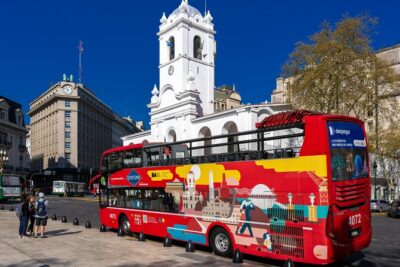 ★ 4.5Buenos Aires Hop-On Hop-Off Bus, Free Walking Tours & DiscountsFrom $392,218 reviews
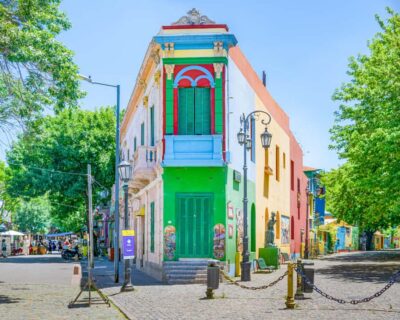 ★ 4.8La Boca Guided Walking Tour in EnglishFrom $131,587 reviews
 ★ 4.9Nazis in Buenos Aires: a historical walking tourFrom $25193 reviews
 ★ 4.7Personalized 2 to 8-Hour Private Walking TourFrom $37149 reviews
 ★ 4.8San Telmo and Market Guided Walking TourFrom $13102 reviews
 ★ 4.5Buenos Aires Walking Tour with Local Guide and Optional RooftopFrom $11187 reviews
 ★ 5.0Full Day Private Walking Tour of Buenos Aires NeighborhoodsFrom $13555 reviews
 ★ 4.8La Boca Art and History Walking TourFrom $4655 reviews
Where this tour also appears